
Building a British hedgerow: picking the species for the Wild Orchard Hedgerow pack
How I chose elderberry, blackthorn, hawthorn and sea buckthorn for the next Wild Orchard pack, what each one demanded from the pipeline, and the species that did not make it in.
Update, 7 October 2026: the Hedgerow pack is now out on the Unity Asset Store.
Most tree packs are built to be looked at. You place them along a ridge, you get a nice silhouette, and that is the end of their job. That works fine for a lot of games, but it is not much use if the player is supposed to walk up to a tree and do something with it.
The games I keep building for are the ones where the scenery is also the inventory. Survival games where you are foraging because the food bar is going down. Post apocalyptic settings where an overgrown field boundary is one of the few reliable places to find calories. Farming and cosy games where gathering is a loop rather than a one off. In all of those, a tree is a container with a refresh timer on it, and the interesting question is not how it looks from a distance but what it gives you when you get there.
That is the thinking behind Wild Orchard, and it is why the Hedgerow pack is built around a field edge rather than another set of standalone trees.
#Why a hedgerow
A hedgerow is not really a row of trees. It is a mixed thing, a boundary that happens to be made of plants, and in Britain it has been doing several jobs at once for a few hundred years. It marks a field edge. It stops animals crossing. It feeds birds through the winter. If you grew up anywhere rural in the UK you have probably eaten out of one at some point.
For a game that combination is unusually convenient. A hedgerow blocks movement, which gives you level design. It is a food source, which gives you a gathering loop. It reads instantly as a boundary, so a player understands where they are allowed to go without a single piece of UI. A row of decorative oaks can block, but not much else.
It is also, I think, a bit under used. There are plenty of generic tree packs out there and not many that are specifically a British field edge. Whether that gap exists because nobody wanted it or because nobody got round to it, I honestly do not know yet. The Hedgerow pack is partly me finding out.
#What I was selecting for
Once I had settled on the theme I still had to pick species, and there are more candidates than slots. These are the five things I ended up weighing, roughly in order of how much they mattered.
Does a player recognise it. Not by name necessarily, but by shape and by fruit. If someone in the UK or Europe looks at it and thinks "I know that one", then the job of communicating its functionality becomes much easier.
Does it yield something a loop can use. Ideally something with a season, a quantity, and a reason to come back. A tree that produces nothing is just decoration.
Is it distinct from the others at twenty metres. This is the one that cuts the most candidates. Four trees that all read as green mass with red dots are four versions of the same asset, whatever the botany says.
Does it have readable seasonal states. Bare, flowering, in leaf, fruiting. The bigger the visual swing between those, the more the state system earns its place.
Can it be built inside the system I already have. TreeDefinition and the rest of the Wild Orchard setup handle a lot, but not everything, and a species that needs special casing costs a lot more than it looks like it will.
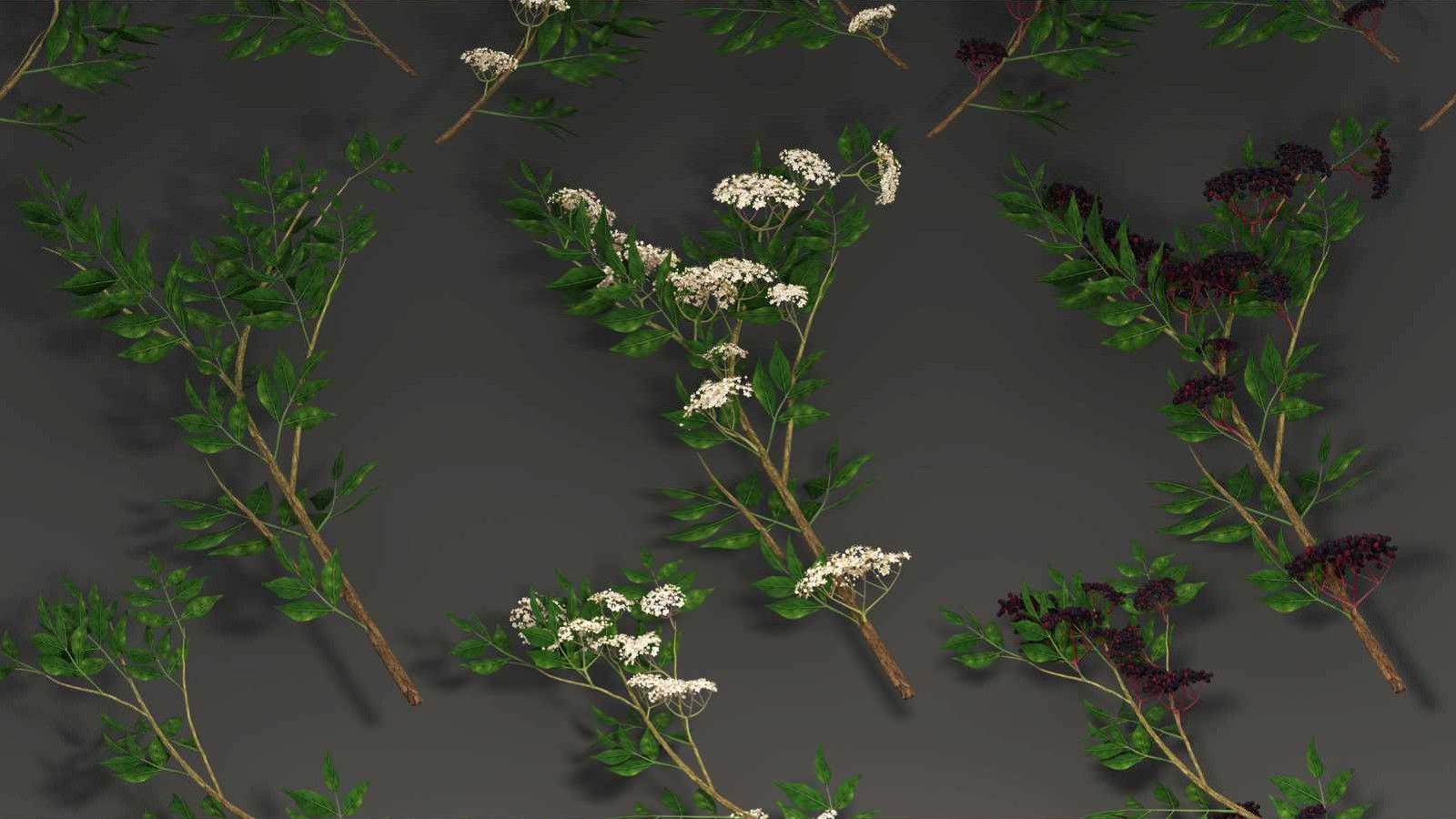
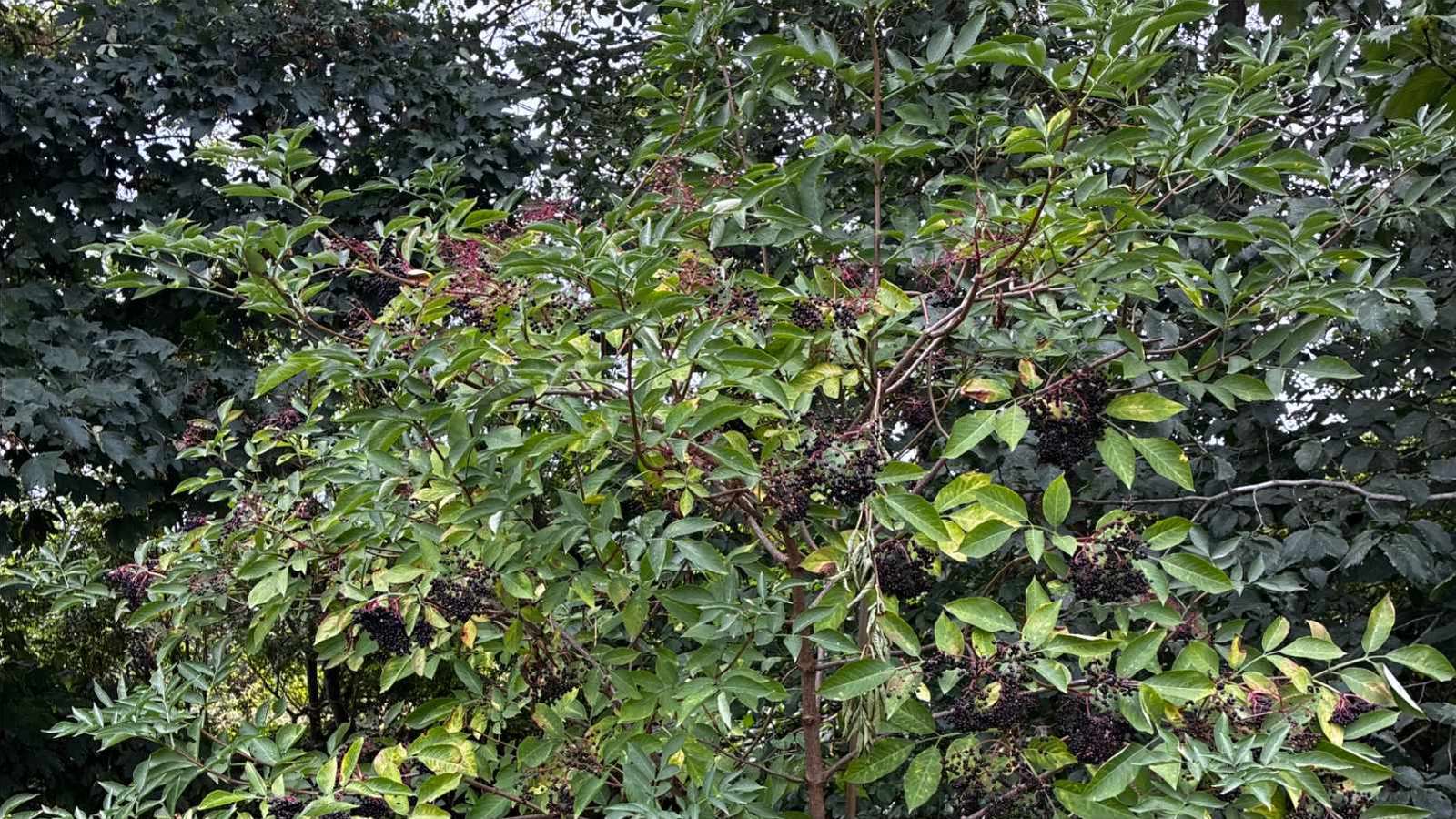
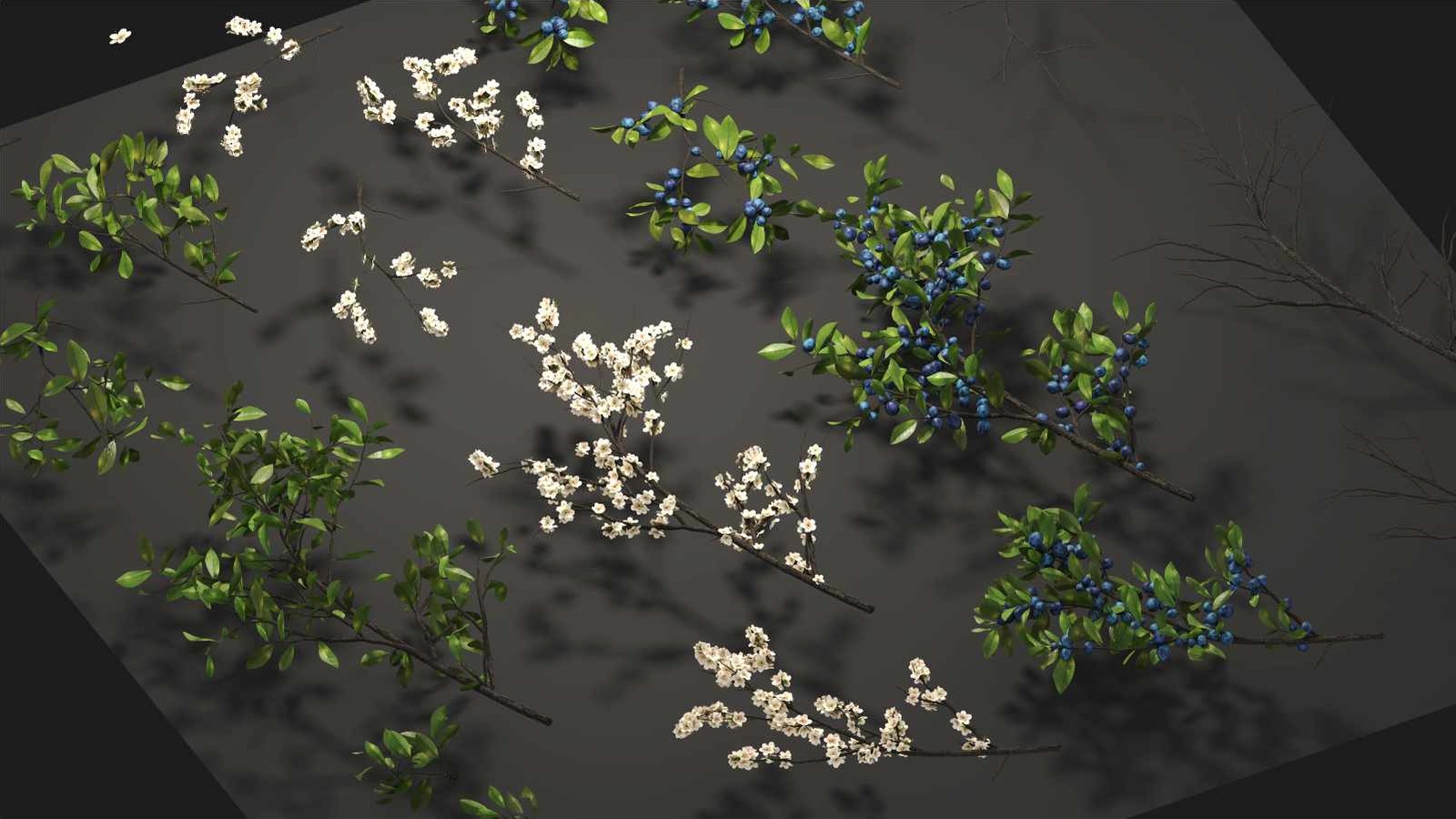
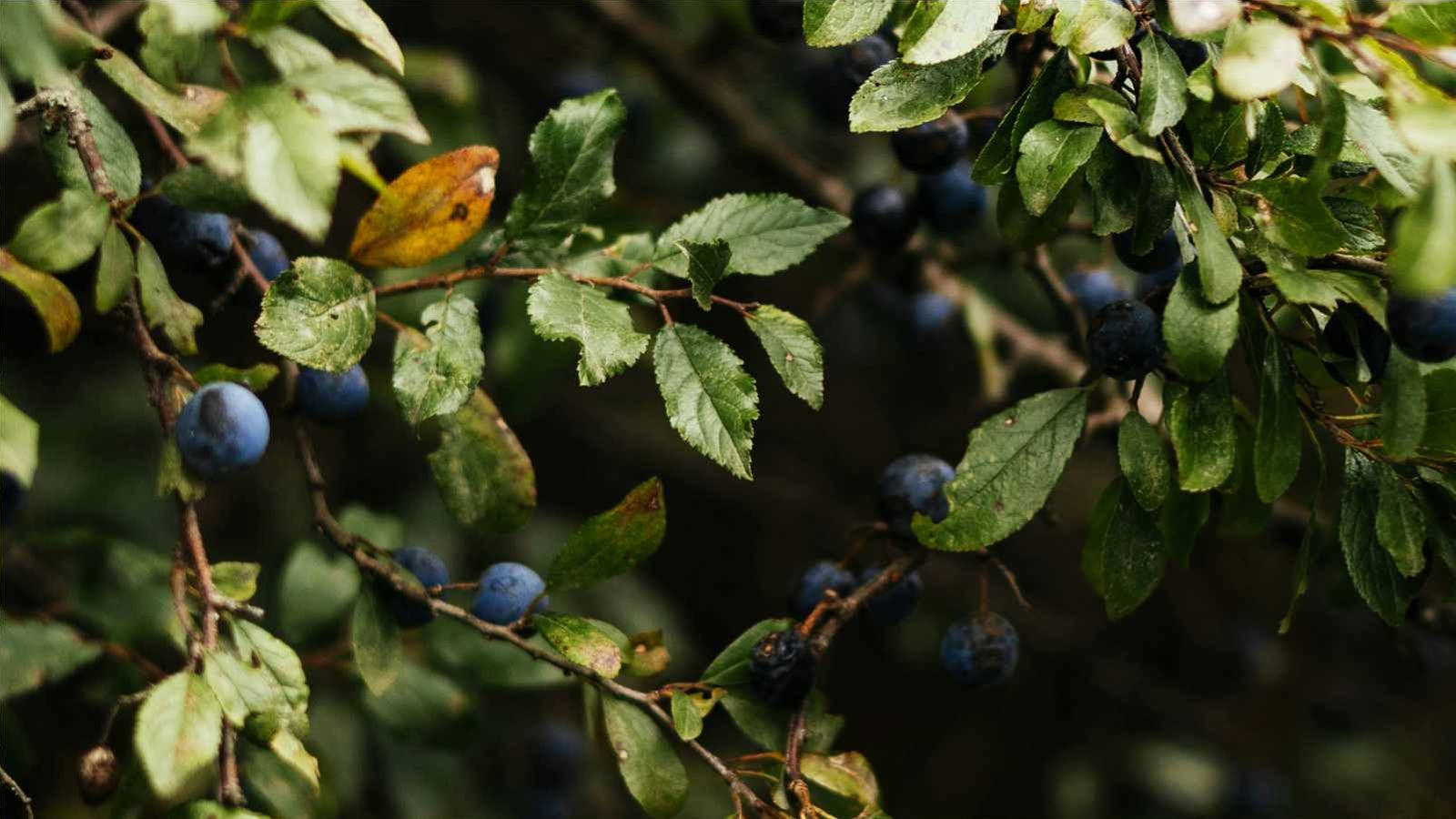
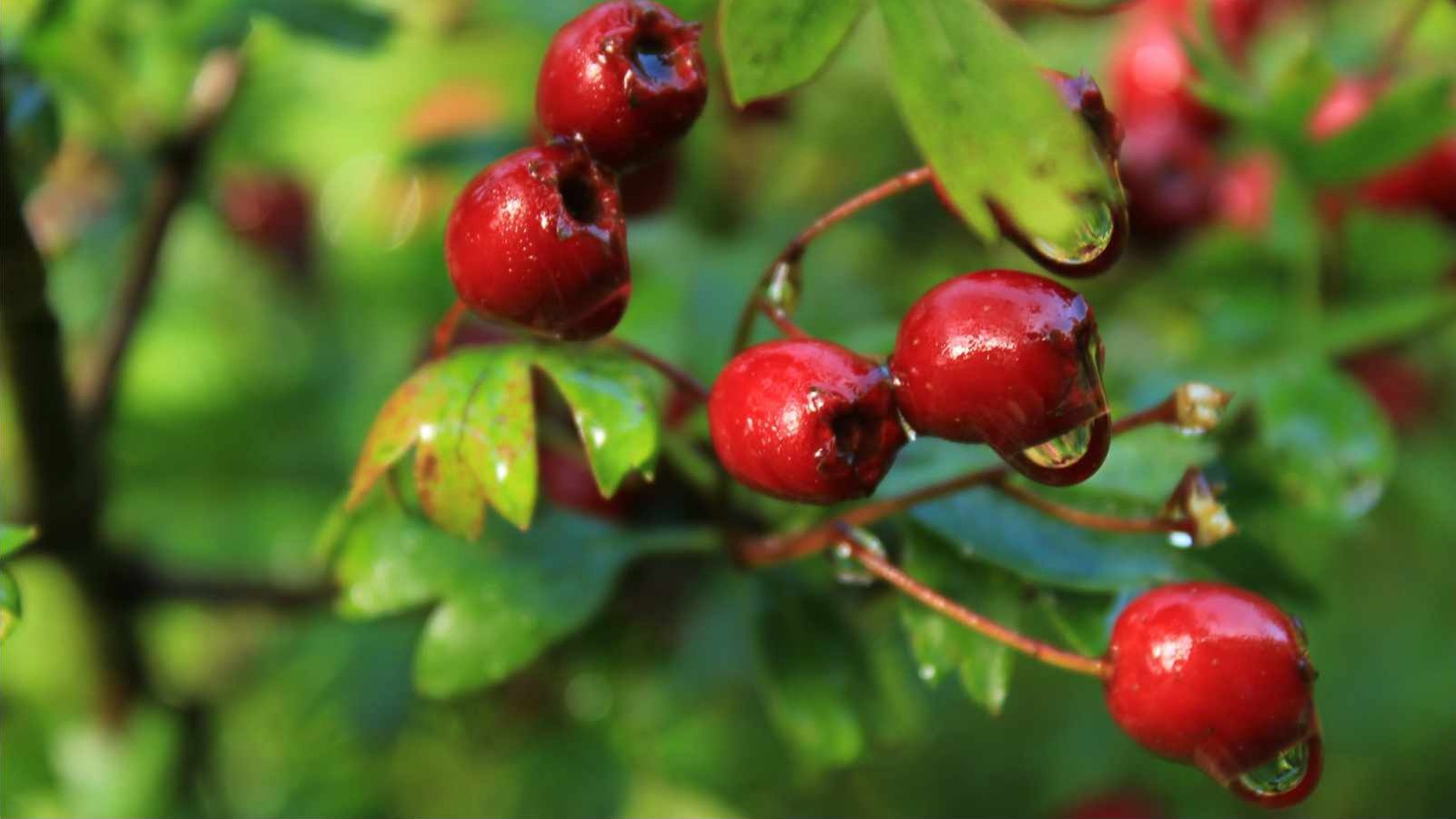
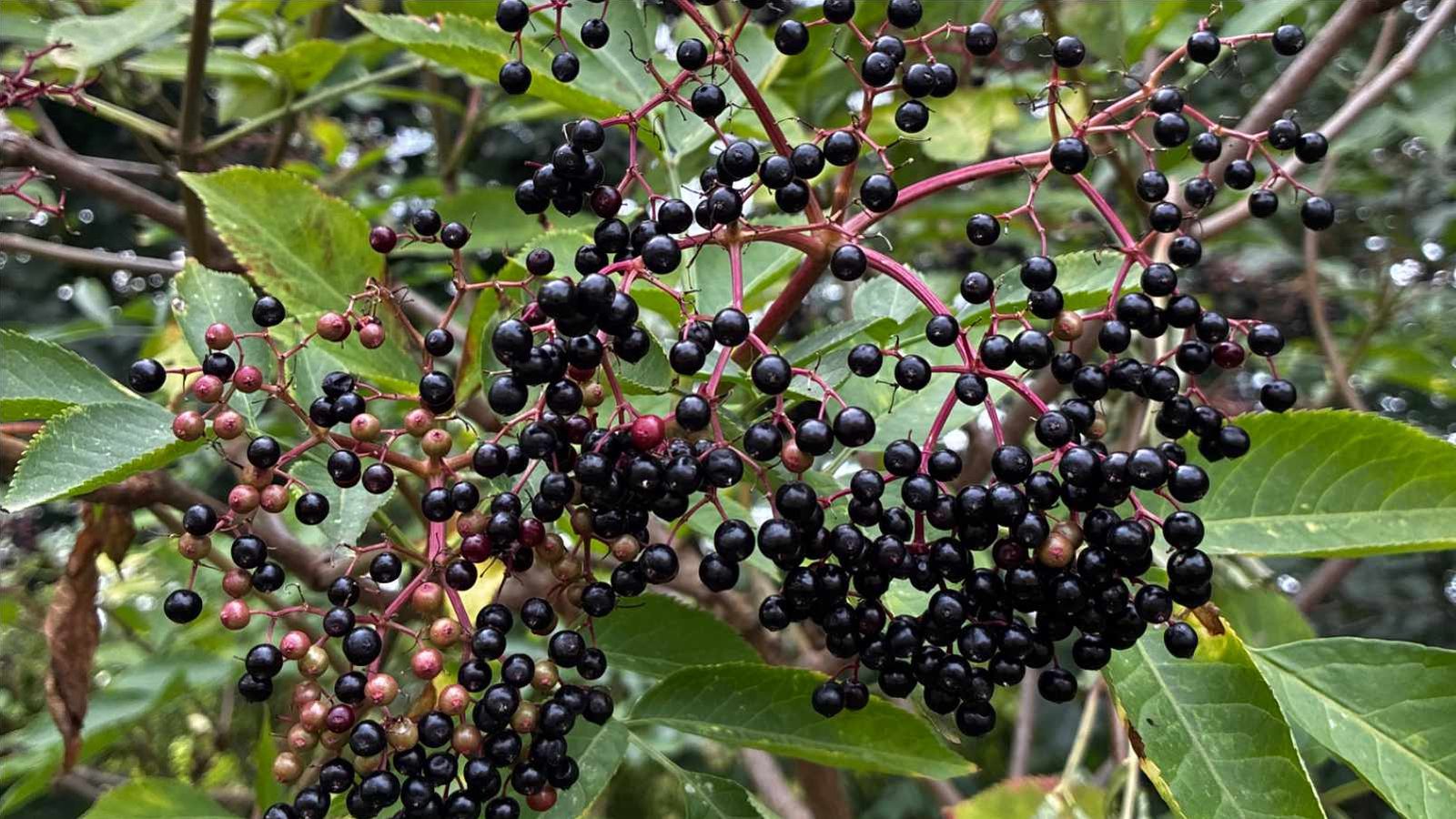
A quick note on the pictures in the next few sections. Each species gets a shot of its branch cards with every seasonal state laid out together, followed by a photo of the real plant which I used for reference.
#Blackthorn
Blackthorn is in the pack for a silhouette I have not been able to get any other way.
It flowers before it comes into leaf, so for a few weeks it is bare black twigs covered in white blossom and nothing else. That gives the hedgerow a state that is unmistakably early spring without needing any environmental cue around it.
Sloes are the yield, and they come with a timing hook built in, because traditionally you do not pick them until after the first frost. Something a developer may well want to wire into their game.
#Hawthorn
If blackthorn is the character of the hedgerow, hawthorn is the structure of it. It is the species traditionally used for hedge laying, so a British hedgerow without hawthorn in it is not really a hedgerow.
It is also the hardest one to build well. Hawthorn grows dense and twiggy, lots of fine branching in a tight volume, and that is close to a worst case for foliage. Fine twigs either cost you a lot of geometry or get flattened into cards that read as mush from the wrong angle, and the transition between LODs is where the mush becomes visible. Most of the awkward pipeline time on this pack has gone into hawthorn, and I would say it is the asset where I am least certain I have landed it.
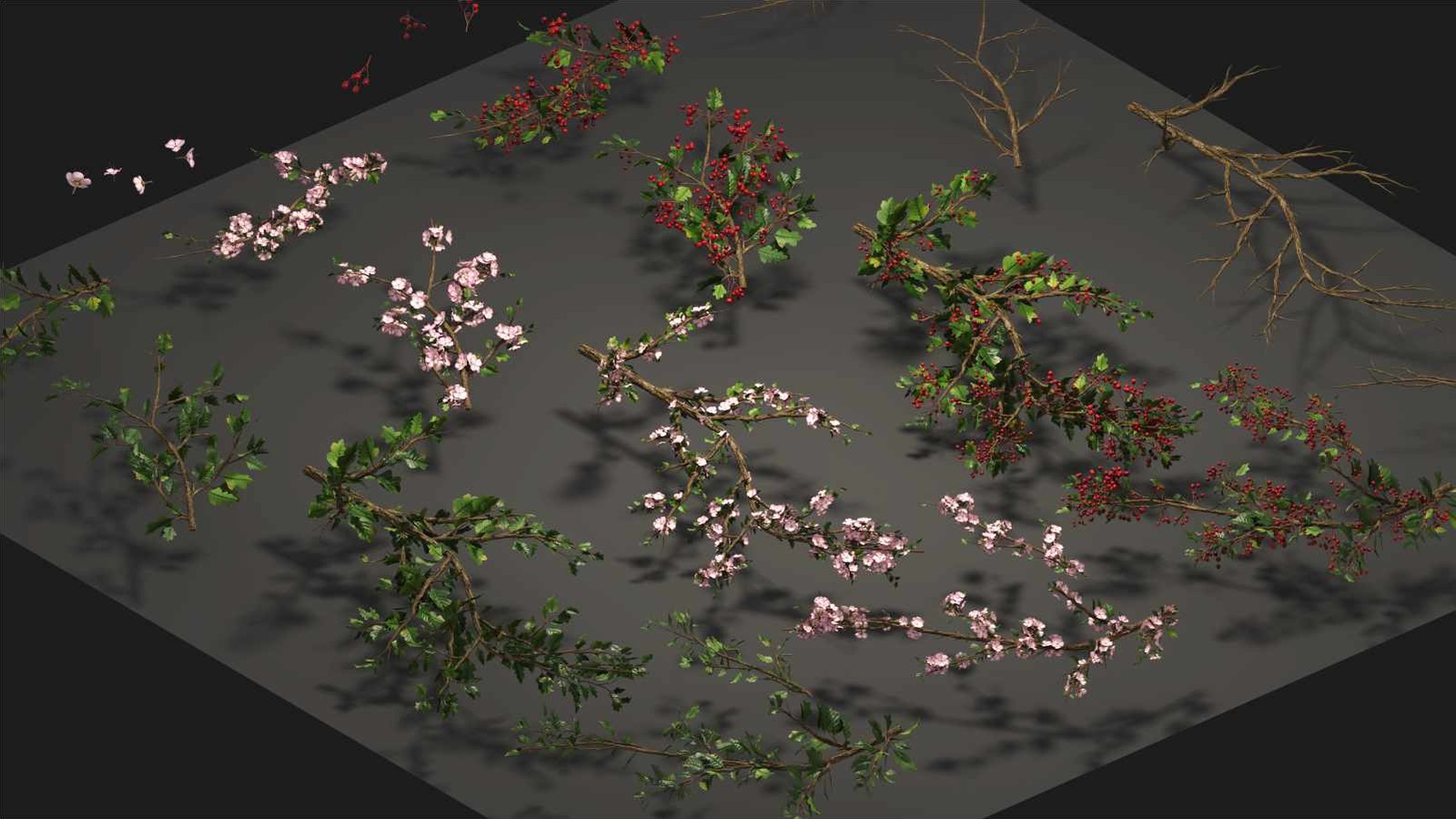
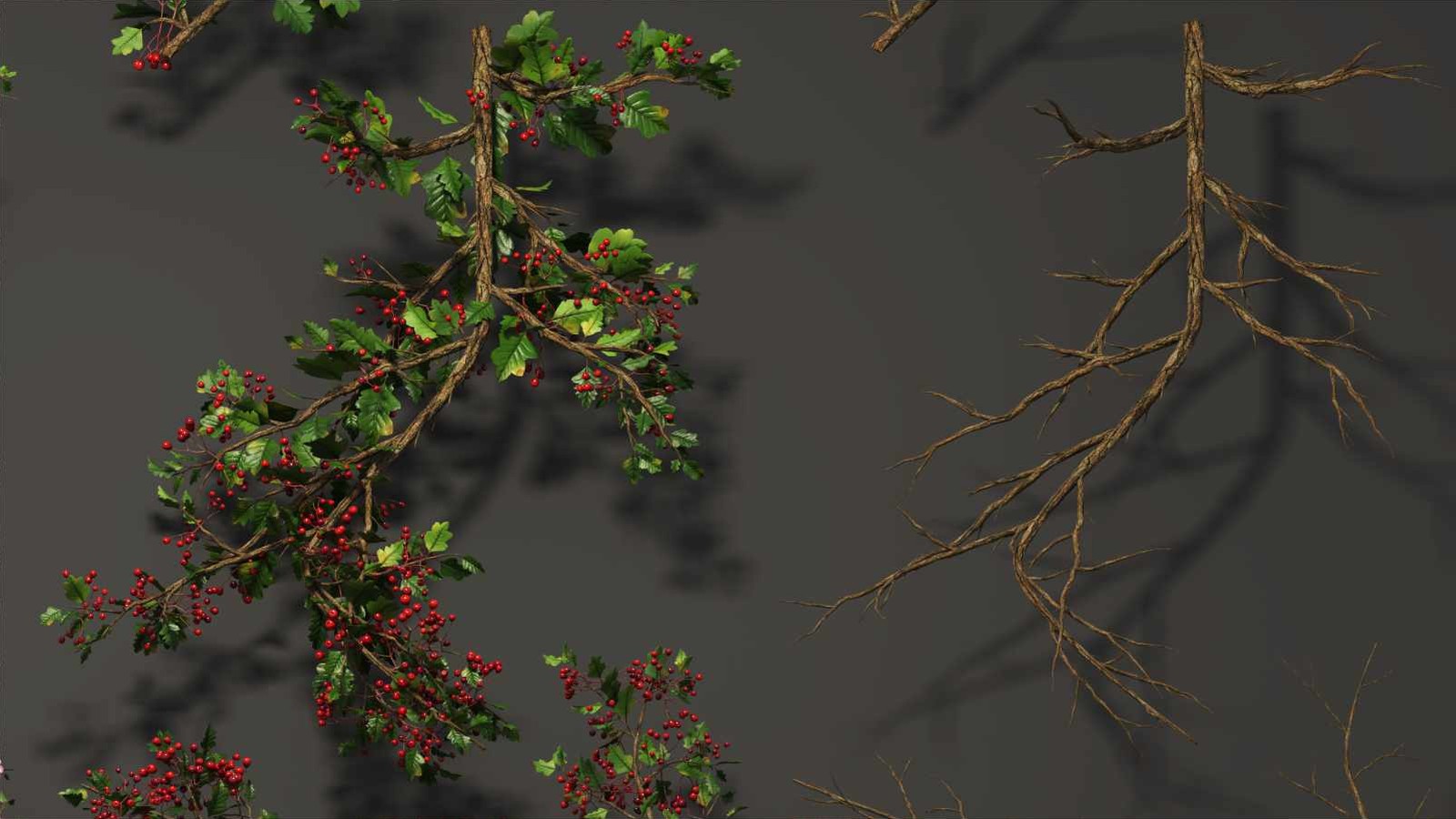
On the gameplay side haws are the opposite of sloes. Low value, but a lot of them, and they hang on into winter. Having one species that is abundant and cheap alongside one that is scarce and seasonal gives whoever is designing the loop something to balance against.
#Elderberry
Elder was the first one locked in, mostly because of how much it changes through the year.
In flower it is covered in big flat umbels, almost white, and they sit on the outside of the canopy where you can see them. Then those same clusters become dark berries. That is the strongest before and after in the whole set, and it means the seasonal states are obvious to a player who is not paying close attention, which is most players.
Technically the cluster structure is the useful part. The umbels give me natural attachment points, so the flower geometry and the fruit geometry sit in the same places and the pickup points come almost for free rather than being scattered around by hand. Elder also grows as a soft multi stem rather than a single trunk, which gives the hedgerow line a looser, scruffier shape than a row of trained trees would.
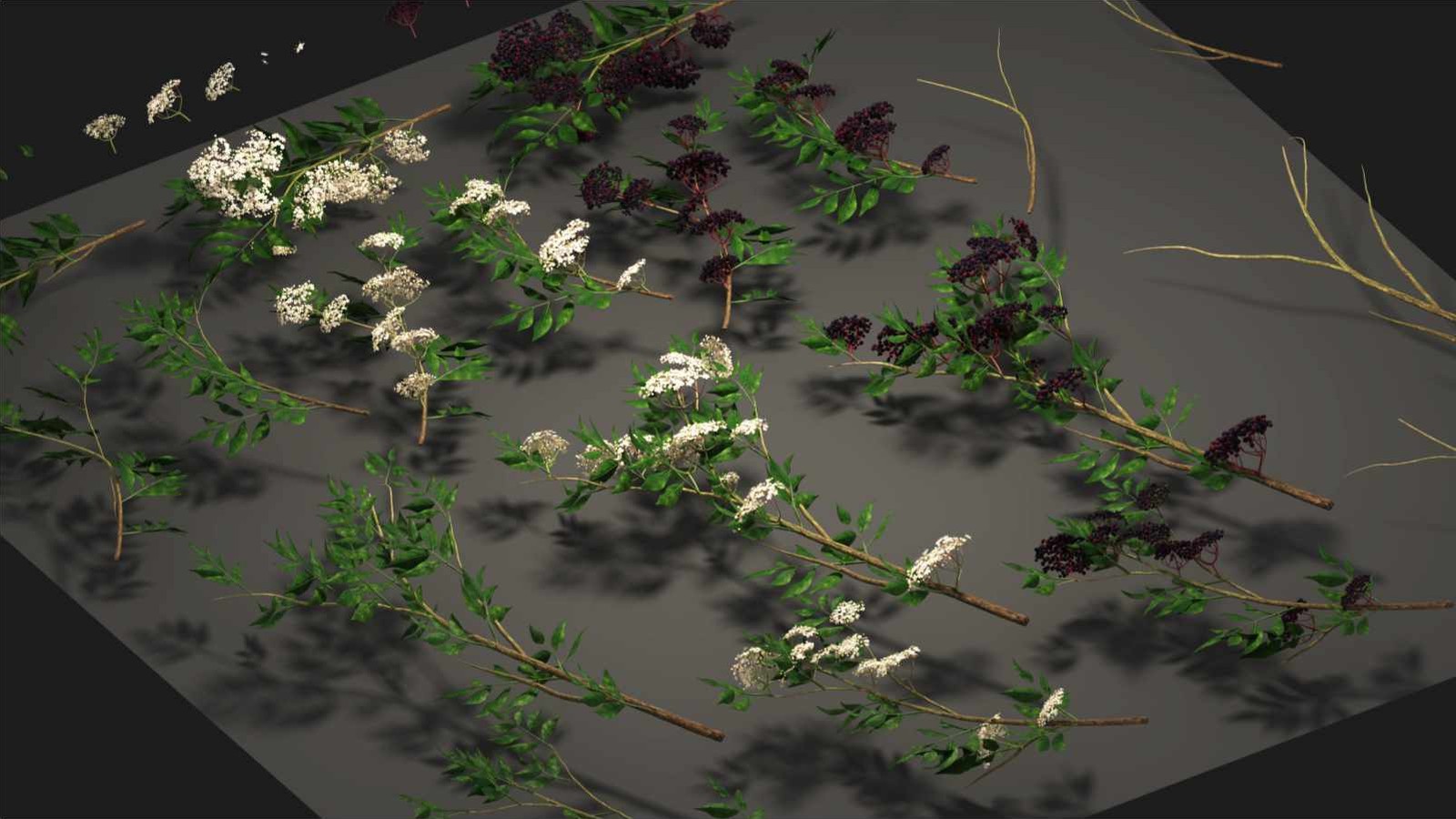
Elderflower and elderberry are both things people actually forage, which helps on the recognition test.
#Sea buckthorn, which is a bit of a cheat
I should be upfront about this one. Sea buckthorn is not a hedgerow species. It is coastal, you find it on dunes and shingle, and if you know British hedges you will have already noticed it does not belong in a list with the other three.
I went with it anyway, for three reasons.
It is widely planted here, just not in hedges. It turns up in shelterbelts and in dune stabilisation planting, so it is not exotic in a British setting, it is just in a different part of it. Living near the Norfolk coast probably makes me more sympathetic to it than most.
It gives the set a colour it otherwise does not have. Elder, blackthorn and hawthorn are all variations on dark green with dark or red fruit. Sea buckthorn is silver grey with dense orange berries, and dropping it into the line is the difference between four trees and four distinguishable trees. That distinctness test was one of my five, and crab apple (which was the other option and would have been considerably cheaper to build given the apple work already done for the Fruit Trees pack) failed it against the existing catalogue.
And the berries are a different problem to solve. They clamp tight to the stem rather than hanging in clusters, so the attachment logic that elder and hawthorn share does not transfer. That is more work, but it means the pack covers two genuinely different berry arrangements instead of three flavours of one.
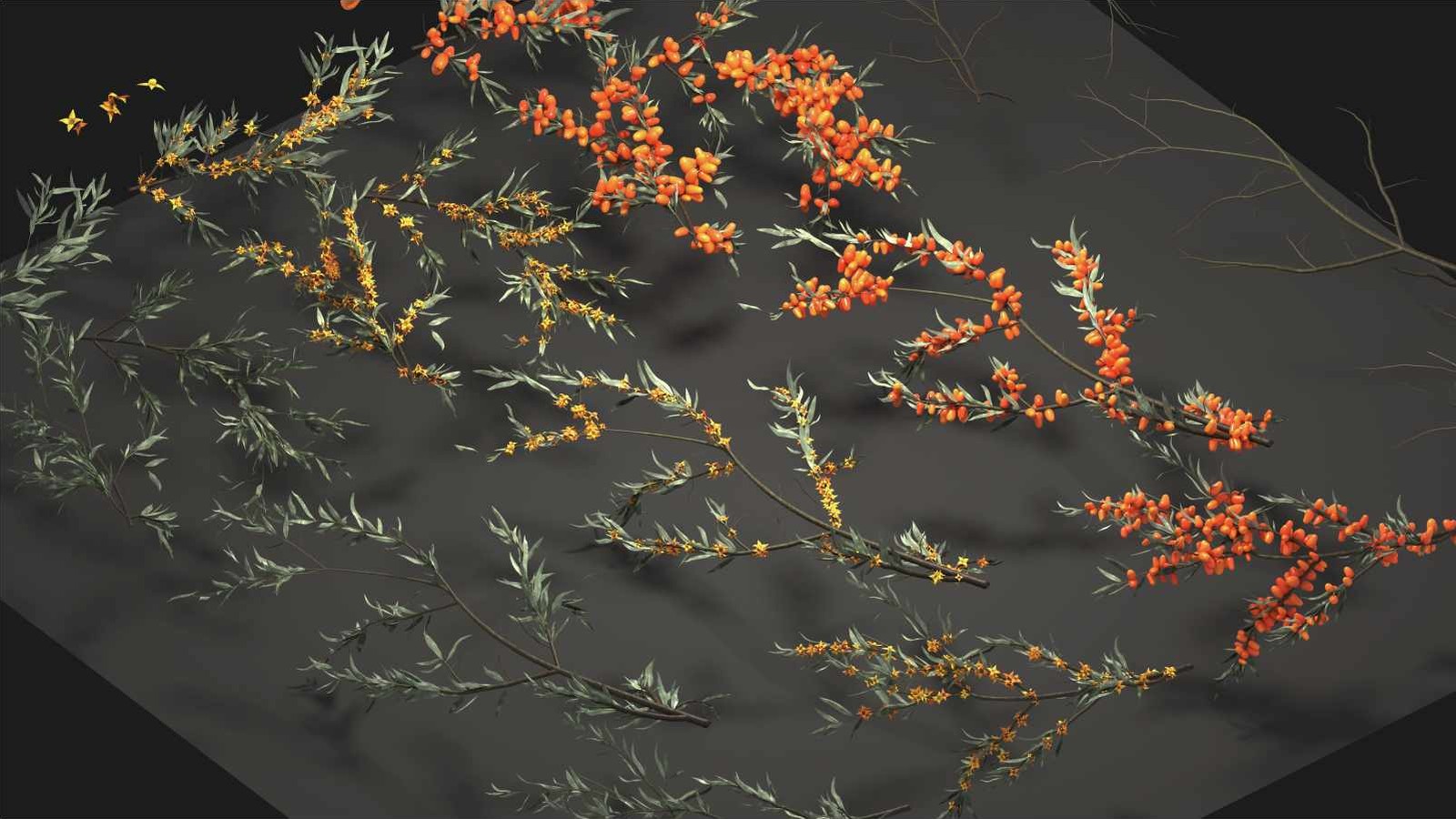
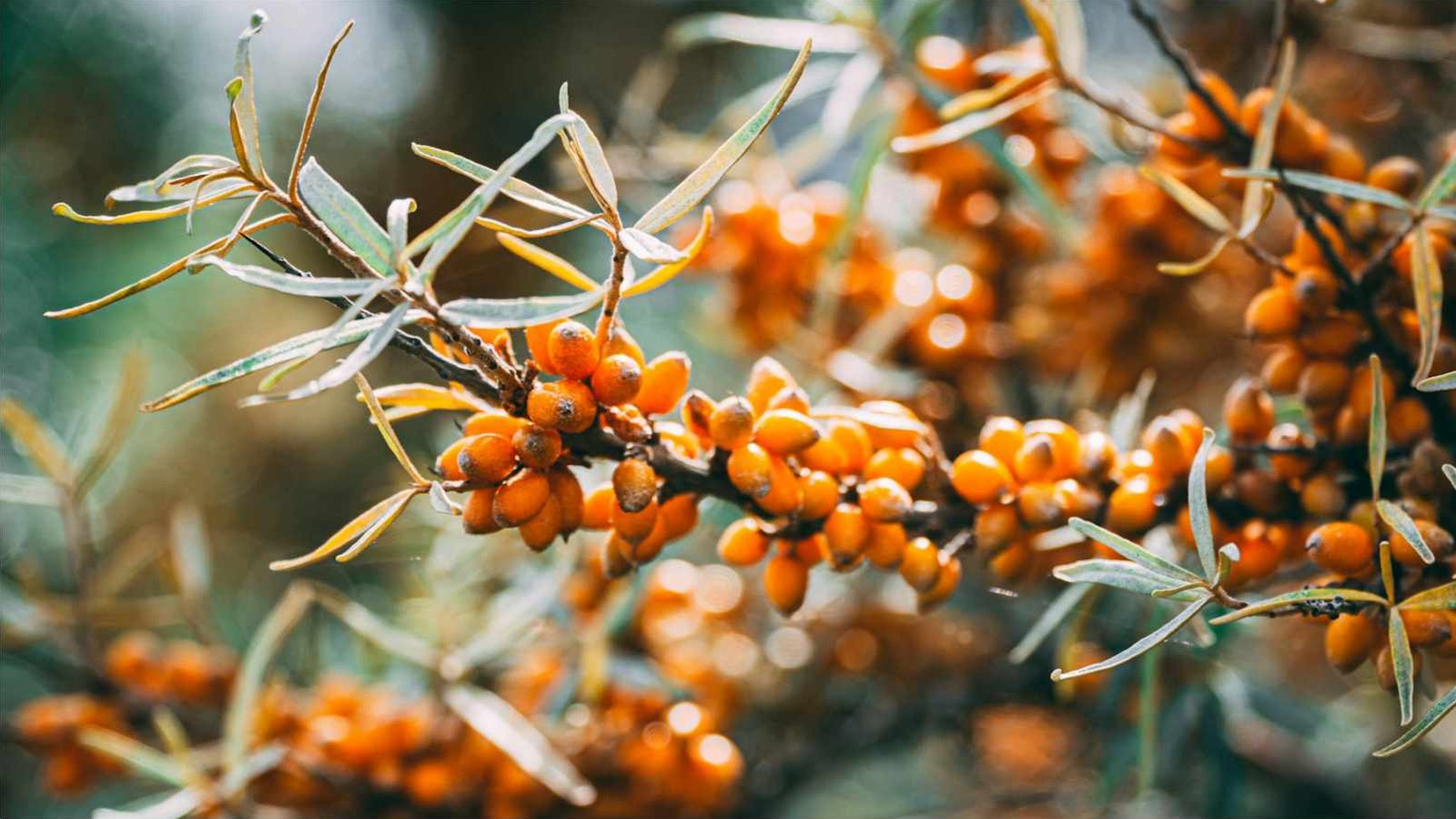
The flowers are scaled up on purpose. Real sea buckthorn flowers are tiny and easy to miss, so I have made them larger to help the flowering state read clearly at gameplay distance.
It might be the wrong call. It is the choice in this pack I would most expect someone to argue with, and if you want to argue with it then my Discord server is the place!
#What did not make it
The five criteria were more useful for rejecting things than for choosing them.
Dog rose came closest. Hips are a good yield, the colour is right, and it is properly hedgerow. It lost because it is a scrambler rather than a tree, so it would have needed its own growth handling, and that is a different kind of asset rather than a fourth entry in this one.
Field maple is a real hedgerow species with excellent autumn colour and no yield worth gathering. Under a purely visual brief it would have been in.
Guelder rose and spindle both have striking fruit, spindle especially, and both fell over on recognition. Outside of people who already know hedges, I do not think either reads as anything in particular.
Holly and hazel are both defensible and both already have a route into the catalogue elsewhere, so they would have been repeating rather than adding.
#A note on how these packs get found
One thing I have been chewing on since the last launch is how little control you have over discovery on an asset store. Two packs can be built to the same standard, documented the same way, priced the same way, and still find very different sized audiences, and the difference comes down to which category shelf they land on and what people were already searching for. The work is only part of it.
I do not have a fix for that. What I have taken from it is that being specific is probably safer than being general, because a pack that is exactly one thing is easier to search for than a pack that is broadly good. A hedgerow pack aimed at British and northern European settings is narrower than a tree pack, and narrow might turn out to be the point.
Or it might not. Time will tell.
#Where this leaves the Hedgerow pack
Four species, picked against five criteria, one of which I have knowingly bent. Blackthorn for the bare blossom silhouette, hawthorn for the structure, elderberry for the seasonal swing, sea buckthorn for the colour and the different berry problem.
When I first wrote this I was still wrangling the 70-odd meshes that make up each tree and moving them into Unity. That work is done, and the pack is now out on the Unity Asset Store.
If you want to see how the system underneath this works, the Hedgerow pack shares the same setup as the other Wild Orchard packs, and you can find all three in the catalogue over here.
Build with the packs behind these posts.
Production-ready, gameplay-functional 3D asset packs for Unity and Unreal.